
Download
Get the template
Thanks. Your download should start now.
Free sample, provided as is. Not legal advice. Adapt it to your state's laws and review it with your attorney, HR and IT before adopting it. Free to use and adapt for your organization; please don't resell it. Current as of October 2026.
What this is and who it's for
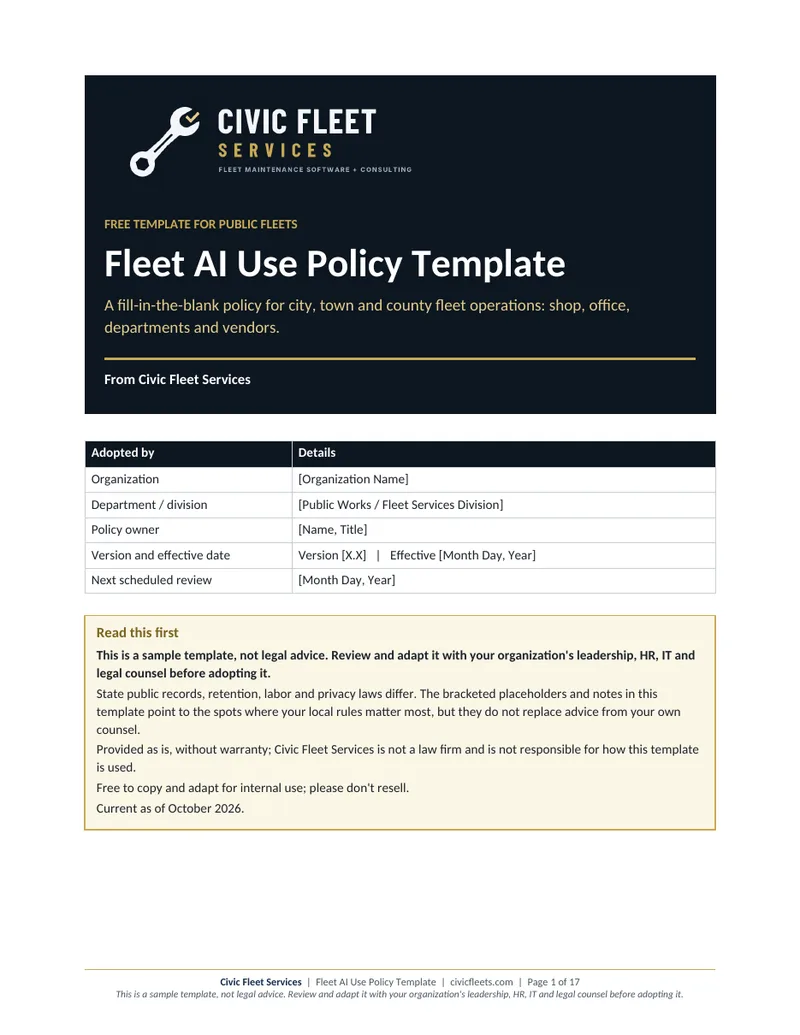
A policy that sets the rules for which AI tools may be used, what information may go into them, who is responsible for the results, and what to do when something goes wrong. In the template's words, the goal is not to ban AI or to chase it: it is to make sure a vehicle that leaves the shop is still safe, a driver is still treated fairly, a bid is still awarded honestly, and a record is still kept the way the law requires.
It covers fleet staff, technicians and mechanics, fleet administrative staff, department users (Department Heads, Department Admins, Department Reps, drivers and equipment operators), and contractors and vendors through contract terms. It applies to stand-alone AI tools and to AI features built into software you already use, such as the FMIS, telematics, camera, fuel and parts systems.
What's inside
- Purpose, scope and who this policy covers
- Definitions
- Approved AI tools and how to request a new one
- Acceptable and prohibited uses
- Fleet data classification and tool tiers
- Human review and accountability
- Telematics and AI features in vendor systems
- Public records and retention
- Procurement and vendor contracts
- Accuracy, bias and transparency
- Training, questions and reporting problems
- Review cycle, approvals and employee acknowledgment
- Appendix A. Can I use AI for this? Shop floor quick check
It opens with a one-page short version, for example: use only AI tools on the approved list, never put restricted data into an AI tool, and a named person owns every AI-assisted work product.
How to adapt it for your city
- Replace every [BRACKETED] field with your organization's information.
- Read the Guidance notes, which explain why each section is there and what to think about, then delete them before you adopt the policy.
- Cut what does not fit your operation and add what is missing. A two-person shop and a 1,000-unit county fleet will not end up with the same policy.
- Run the draft past HR, IT and security, procurement, the records officer, legal counsel and, where you have one, your labor union, before it goes to your approving authority.
Questions
Is the template free?
Yes. It is free to use and adapt for your organization. Please don't resell it.
Do I need to give my email?
Yes, an email address. Your name is optional. The PDF downloads right away, and we only send occasional fleet resources if you check the box.
What is in the PDF?
17 pages: a one-page short version, 12 policy sections with [BRACKETED] fields and guidance notes, an employee acknowledgment, and a shop floor quick check (Appendix A).
Who should review it before we adopt it?
The template suggests HR, IT and security, procurement, the records officer, legal counsel and, where you have one, your labor union, before it goes to your approving authority.
Is this legal advice?
No. It is a free sample. Adapt it to your state's laws and review it with your attorney, HR and IT before adopting it.
Related templates
Vehicle Use and Take-Home Vehicle Policy Template
A fill-in-the-blank policy for who may drive public vehicles, how they are used, and when they go home overnight.
View the templateFueling and Fuel Card Use Policy Template
A fill-in-the-blank policy for fueling vehicles and equipment, and controlling fuel cards and on-site fuel.
View the templateFleet Operations Manual Template
A ready-to-adapt operations manual: work orders, preventive maintenance, inspections, condition-based replacement and the forms that hold it together.
View the template