
Download
Get the template
Thanks. Your download should start now.
Free sample, provided as is. Not legal advice. Adapt it to your state's laws and review it with your attorney, HR and IT before adopting it. Free to use and adapt for your organization; please don't resell it. Current as of October 2026.
What this is and who it's for
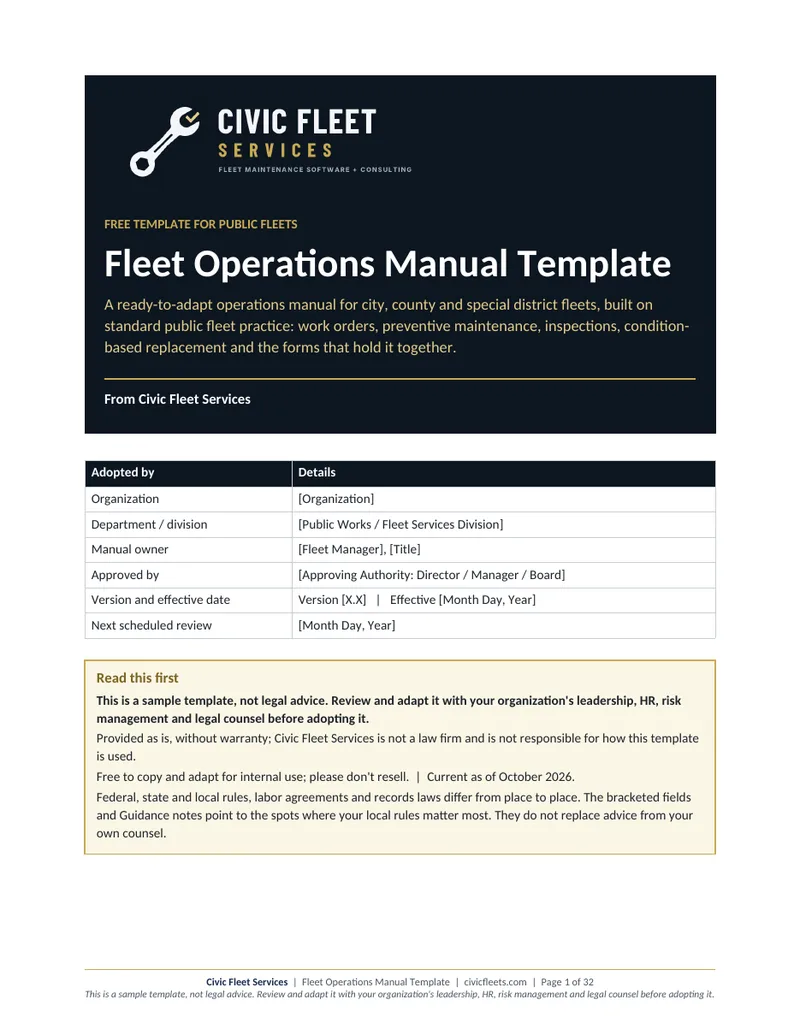
A manual that sets the standard practices your organization uses to buy, maintain, inspect, fuel, assign, replace and dispose of its vehicles and equipment. In the template's words, its goals are to keep the fleet safe, keep units available for the departments that depend on them, control life-cycle cost, comply with applicable regulations, and keep accurate records that stand up to audit and public review.
It applies to owned, leased and rented vehicles and powered equipment: light-duty vehicles, medium- and heavy-duty trucks, off-road and construction equipment, and specialty units such as public safety vehicles, fire apparatus, aerial devices, refuse and sweeper units. It applies to every employee who operates, maintains, assigns or manages these assets, and to contractors when they work on them. The manual is software-neutral.
What's inside
- Purpose, scope and authority
- Roles and responsibilities
- Fleet operating model options
- Asset acquisition and onboarding
- Asset records and meter readings
- Operator duties and daily inspections (DVIR)
- Work requests and the work order lifecycle
- Preventive maintenance program
- Inspections and regulatory compliance
- Parts and inventory
- Outside vendors and sublet repairs
- Warranty and recalls
- Accidents and damage
- Downtime and availability
- Fuel management
- Tires
- Condition rating and replacement planning
- Disposal and surplus
- Motor pool and vehicle use
- Safety and shop practices
- Key performance indicators
- Records retention and public records
- Annual manual review and revision
- Appendices A to H: in-service checklist, daily inspection / DVIR, PM checklist example (A/B/C), work request form, accident and damage report, condition rating worksheet, disposal request, policy acknowledgment
It opens with the manual on one page, for example: every repair, PM and inspection is done on a work order with the 3 Cs (complaint, cause, correction), and replacement is planned from scored condition data, not from age alone.
How to adapt it for your city
- Replace the few [Bracketed] fields: mainly [Organization], [Fleet Manager] and [Fleet Software]. Everything else is written to work as is.
- Where shops differ, the manual gives options (for example, in-house vs outsourced shop, or chargeback vs general fund). Keep the option that matches how you operate and delete the rest.
- Delete the italic Guidance notes before adoption.
- Treat benchmarks and intervals as common starting points, not requirements. Set your own targets from your fleet's history, OEM guidance and regulations.
Questions
Is the template free?
Yes. It is free to use and adapt for your organization. Please don't resell it.
Do I need to give my email?
Yes, an email address. Your name is optional. The PDF downloads right away, and we only send occasional fleet resources if you check the box.
What is in the PDF?
32 pages: the manual on one page, 23 sections with Guidance notes, and 8 forms and checklists (Appendices A to H).
Who should review it before we adopt it?
The template says to review and adapt it with your organization's leadership, HR, risk management and legal counsel before adopting it.
Is this legal advice?
No. It is a free sample. Adapt it to your state's laws and review it with your attorney, HR and IT before adopting it.
Related templates
Pre-Trip Inspection and PM Compliance Policy Template
A fill-in-the-blank policy for daily operator inspections, defect reporting, PM schedules and the follow-through that keeps units safe.
View the templateVehicle Use and Take-Home Vehicle Policy Template
A fill-in-the-blank policy for who may drive public vehicles, how they are used, and when they go home overnight.
View the templateAccident and Damage Reporting Policy Template
A fill-in-the-blank policy for what drivers do at the scene, who gets told, how damage is documented and how crashes are reviewed.
View the template